The AI Factory: What India's AI Moment Reveals About Fear, Systems and Execution
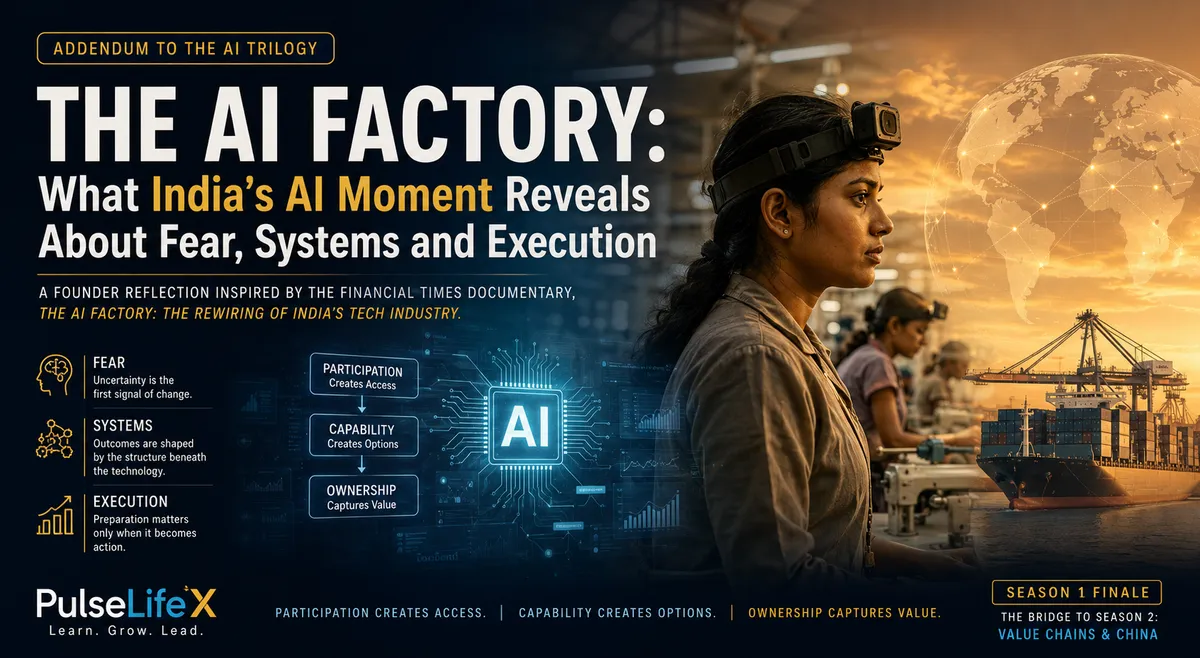
There is a textile factory in Karur, Tamil Nadu where workers arrive each morning and begin doing work that would look familiar to anyone who has ever spent time around a production floor.
They stitch garments. They fold fabric. They sort materials. They move products through a sequence of tasks that has existed in one form or another for decades.
At first glance, nothing appears unusual.
The factory is busy. The work is real. The routines are familiar.
The only difference is that many of the workers are wearing cameras on their foreheads.
Every movement is being recorded.
Not to monitor productivity. Not to train new employees. Not for quality audits.
The recordings are being used to train machines.
Somewhere, a robot is learning how to perform these same tasks by watching thousands of hours of accumulated human experience transformed into data.
The workers receive additional income for participating. The company receives valuable training data. The machines receive an education.
Everyone appears to benefit.
At least for now.
The Question That Stayed With Me
When I first encountered this story, I expected to spend most of my time thinking about artificial intelligence.
Instead, I found myself thinking about something else entirely.
Over the years, I have watched similar moments appear across different industries and in different forms. A new technology arrives. New opportunities emerge. New sources of value are created. The conversation usually begins with excitement, optimism, or anxiety. But eventually it settles on a more fundamental question.
Who is actually learning from the change?
And who is simply adapting to it?
That question stayed with me as I watched the workers in Karur.
What felt significant was the possibility that something larger was taking place beneath the surface.
Are they helping build a future they will eventually shape? Or are they helping build a future they will eventually serve?
The Two Stories of AI
One of the reasons discussions about artificial intelligence often become confusing is that people try to force a single narrative onto something that is clearly more complicated.
Technology is good. Technology is bad. AI creates jobs. AI destroys jobs. AI empowers people. AI exploits people.
Most of these arguments contain some truth.
The problem is that reality rarely chooses only one side.
What struck me about the stories emerging from India’s AI economy is that they seem to contain two different narratives running at the same time.
The first is a story of opportunity.
For many people, artificial intelligence is creating forms of work and participation that simply did not exist a few years ago.
Women working from home. First-generation graduates finding access to global projects. Workers in smaller towns participating in industries that were once concentrated in a handful of major cities.
For people who have historically been excluded from the technology economy, these opportunities matter.
Additional income matters. Flexibility matters. Access matters. Exposure to new industries matters.
The second story is unfolding alongside it.
The people creating training data for AI systems are often contributing to value that they may never own.
The platforms are owned elsewhere. The models are owned elsewhere. The intellectual property is owned elsewhere. The largest economic rewards may ultimately accumulate elsewhere as well.
Participation and ownership are not the same thing.
Why the Pattern Felt Familiar
The more I reflected on these stories, the more I realized that what felt familiar was not the technology.
In many ways, the technology was the least familiar part. Artificial intelligence is evolving at a pace that few people fully understand.
What felt familiar were the questions.
Over the years, I have worked across supply chains, sourcing operations, logistics networks, procurement functions, e-commerce businesses, and organizational systems. The industries were different. The products were different. The technologies were different.
Yet the same questions appeared repeatedly:
- Who is creating the value?
- Who is capturing the value?
- Who owns the relationship?
- Who controls the flow of information?
- Who becomes stronger as the system evolves?
- Who becomes easier to replace?
Those questions rarely appear at the beginning of a transition. At the beginning, most people focus on activity. Orders are increasing. New technologies are being adopted. Investment is flowing. Jobs are being created.
Everything appears to be moving forward.
Only later do people begin asking where the value is actually accumulating.
The Systems Beneath the Story
One of the most common mistakes I have seen in business is the belief that technology can compensate for a lack of operational clarity.
The assumption is understandable.
A new software platform promises efficiency. An automation tool promises productivity. Artificial intelligence promises speed, insight, and better decision-making.
The technology appears powerful. The results seem inevitable.
Yet reality is usually more complicated.
Over the years, I have watched organizations invest significant time and money implementing new systems, only to discover that the real constraint was never the technology itself.
The constraint was the way the business operated.
Processes were inconsistent. Responsibilities were unclear. Data meant different things to different teams. Critical knowledge existed only inside the heads of a few experienced employees.
The technology did not create those problems. It simply made them impossible to ignore.
“Technology often behaves less like a solution and more like a mirror. It reflects realities that already exist inside a system.”
The National Tutorial Trap
A few years ago, I was involved in a sourcing project where a company believed it had built a strong procurement capability.
From the outside, that belief seemed entirely reasonable. The business had been importing products for years. Suppliers were being engaged regularly. Quotations were collected. Orders were placed. Containers arrived. Revenue was being generated.
Then conditions changed. A supplier relationship became unstable. Lead times started moving unpredictably. Prices became difficult to negotiate.
What emerged was an uncomfortable realization.
The company had participated in sourcing. But much of the sourcing capability sat somewhere else.
The supplier relationships were not really theirs. The market intelligence was not really theirs. The negotiation leverage was not really theirs.
The business had access to those things while the system was functioning normally. It did not truly control them.
That experience stayed with me because I have seen versions of the same pattern many times since:
- People often mistake access for understanding.
- Activity for capability.
- Participation for mastery.
Participation Versus Ownership
The more I reflected on these stories, the more I found myself returning to a question that seemed simple at first and surprisingly difficult once I sat with it for a while.
What is the difference between participating in a future and owning a future?
For most of my career, I have worked around systems that move products, information, money, and decisions from one place to another.
Factories manufacture products. Suppliers source materials. Logistics networks move shipments. Warehouses store inventory. Retailers serve customers.
On the surface, everything appears connected. And it is.
But one lesson kept appearing again and again:
The busiest part of a system is not always the part capturing the most value.
I have seen factories operating around the clock. Warehouses moving enormous volumes of inventory. Procurement teams managing hundreds of suppliers. Logistics networks coordinating thousands of shipments.
Yet a significant portion of the value often accumulates somewhere else.
Sometimes it sits with the brand. Sometimes with the platform. Sometimes with the company that owns the customer relationship. Sometimes with the organization that controls the intellectual property or the standards that everyone else follows.
The activity creates value. But ownership often determines who captures it.
What the Right Kind of Participation Looks Like
Participation is not the problem. What happens inside participation is.
Most important transitions are not won by the people who move first. Nor are they won by the people who move last.
They are often shaped by the people who understand what they are trying to build while everyone else is focused on what they are trying to use.
There is a difference between:
- Participating in change and learning from it
- Using a tool and developing a capability
- Being present in a market and building a position within it
Participation creates opportunity. Capability creates options. Ownership captures value.
The sequence matters.
A Bridge to Global Value Chains
As I reflected on these questions, I found myself thinking less about artificial intelligence and more about something I have spent most of my professional life around: supply chains.
One conversation appears to be about algorithms, data, and machine learning. The other appears to be about factories, sourcing, logistics, procurement, and global trade.
Yet beneath the surface, they are asking remarkably similar questions:
- Who creates the value?
- Who captures the value?
- Who owns the customer relationship?
- Who influences the standards?
- Who occupies the most defensible position within the system?
The technologies change. The industries change. The terminology changes.
The underlying dynamics remain surprisingly familiar.
Closing Reflection
When I began writing this series, I thought I was exploring the impact of artificial intelligence.
Over time, I realized I was really exploring something much broader: how people respond to change.
The first essay explored fear. Not because fear is unusual, but because uncertainty is often the first sign that something important is changing.
The second explored systems. Because once the initial excitement and anxiety begin to fade, outcomes are usually determined less by technology and more by the structures beneath it.
The third explored execution. Because preparation only becomes meaningful when it can be translated into action.
This final reflection began with a simple observation: People can participate in change without fully benefiting from it.
Periods of transition have a way of consuming attention. New technologies emerge. New tools appear. New opportunities attract investment. New risks dominate headlines.
The temptation is to focus entirely on what is changing.
Yet the longer I have worked around businesses, supply chains, operational systems, and markets, the more I have come to appreciate a different perspective.
The greatest advantages often come from strengthening the things that remain important despite the change.
- Judgment
- Adaptability
- Capability
- Trust
- Execution
These qualities rarely generate excitement. They rarely become headlines.
Yet they have a remarkable habit of surviving every technological transition.
🔑 Key Takeaways
- Participation in change ≠ benefiting from change.
- The busiest part of a system isn’t always the part capturing the most value.
- Technology is a mirror — it reflects the systems already in place.
- Access ≠ understanding. Activity ≠ capability. Participation ≠ mastery.
- Participation creates opportunity. Capability creates options. Ownership captures value.
- The greatest advantages come from strengthening what remains important despite change.
📚 The Complete Series
Part 1: The Fear Around AI Feels Familiar: We’ve Been Here Before
Part 2: Most Businesses Are Not Ready for AI. Their Systems Are Already Broken.
Part 3: Students Are Preparing for Exams. Industry Is Preparing for Adaptability.
Part 4: The AI Factory: What India’s AI Moment Reveals About Fear, Systems and Execution (you’re here)
— Mohammad Arshad
Founder, PulseLifeX
Next Steps
- Need help with sourcing?Book a 15-Min Clarity Call
- Want to check hidden cost?Run the Real Shipping Cost Check
- Want to review operations?Run the Business Health Check