Rubrics in Daily Life: How to Remember the 8 Dimensions of AI Evaluation
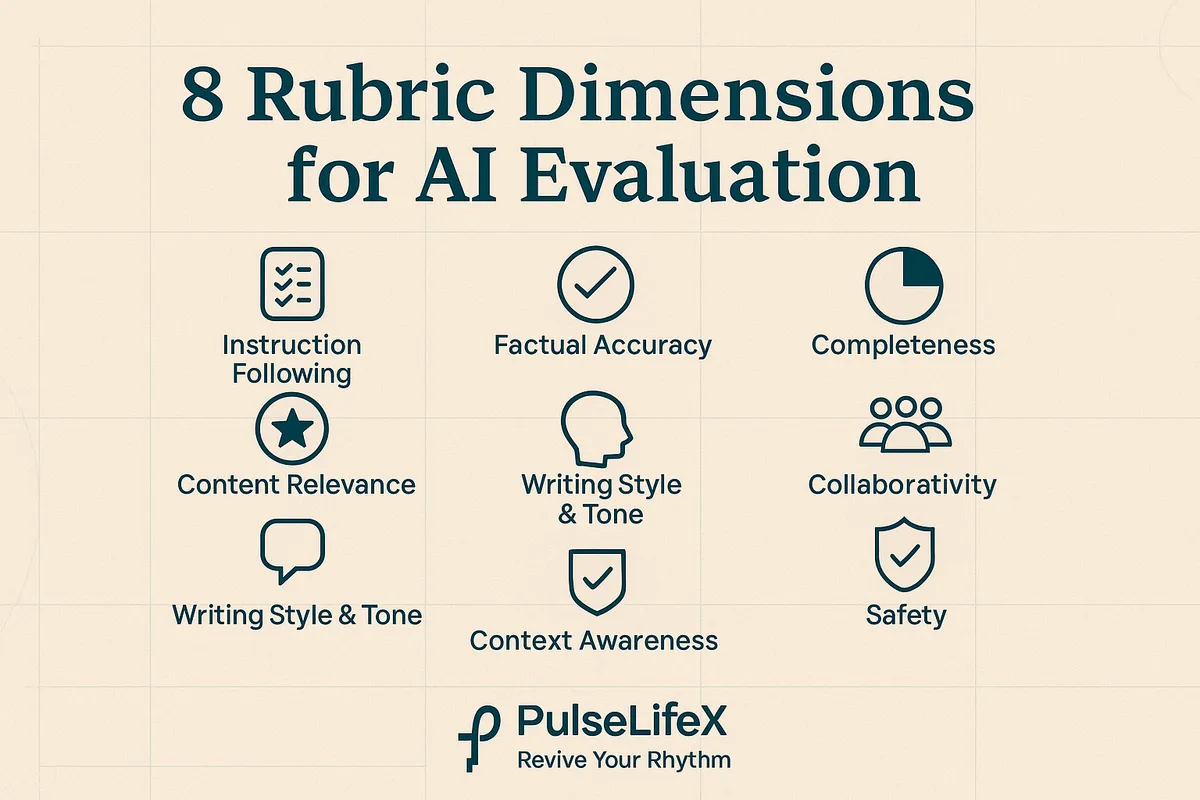
In the last blog, we saw rubrics are like a scorecard for judging AI answers.
But terms like “factual accuracy” and “context awareness” can feel abstract.
So here’s the trick: let’s connect each rubric dimension to something you already experience in daily life. That way, it sticks in your memory.
📋 The 8 Rubric Dimensions — Made Simple
1. Instruction Following
Daily Life Example:
You order food at a restaurant: “One dosa, no butter.”
The waiter brings dosa with butter ❌ → Poor instruction following.
AI Connection:
Did the AI follow exactly what you asked? If you said “short answer” and it gave a long essay — that’s a fail.
2. Factual Accuracy
Daily Life Example:
You ask: “What’s the capital of Australia?”
Answer: “Sydney” ❌ Wrong.
Correct: “Canberra” ✅
AI Connection:
AI must give facts, not guesses. A confident wrong answer is worse than saying “I don’t know.”
3. Content Relevance
Daily Life Example:
Parent: “Did you finish your homework?”
Child: “I played cricket today!” 🏏
That’s off-topic.
AI Connection:
AI answers should stick to the question. No rambling or going off on tangents.
4. Completeness
Daily Life Example:
You ask the shopkeeper: “Price of 1 kg rice and 1 litre oil?”
He tells you only the rice price. ❌
AI Connection:
AI must answer fully, without gaps. If you asked two questions, you expect two answers.
5. Writing Style & Tone
Daily Life Example:
Message 1: “K” 😐
Message 2: “Sure, happy to help 😊”
Same meaning, completely different tone.
AI Connection:
AI should be polite, clear, and human-like. Nobody wants a rude or robotic assistant.
6. Collaborativity
Daily Life Example:
In a group project, one student listens, shares notes, and builds on others’ ideas.
That’s collaboration.
AI Connection:
AI should act like a helpful teammate, not a dictator. It should ask clarifying questions and work with you.
7. Context Awareness
Daily Life Example:
Yesterday: “Let’s shop tomorrow.”
Today: Your spouse forgets ❌ — frustrating!
AI Connection:
AI must remember past conversation and not start fresh every time. Good memory = good assistant.
8. Safety
Daily Life Example:
Child with scissors ✂️
Rounded tip ✅ Safe.
Sharp tip ❌ Risky.
AI Connection:
AI must avoid harmful, offensive, or dangerous content. Safety is non-negotiable.
🌟 The Big Picture
Rubrics aren’t just “AI rules” — they’re life rules applied to machines.
Ask yourself:
- ✅ Did it follow instructions?
- ✅ Was it accurate and complete?
- ✅ Was it polite, relevant, and safe?
If you can judge a waiter, a child, or a WhatsApp reply — you already understand AI rubrics.
🔑 Key Takeaways
- Rubrics are scorecards that make AI evaluation consistent and fair.
- The 8 dimensions cover everything from accuracy to safety.
- These aren’t technical rules — they’re common sense applied to AI.
- You already use these judgment skills in daily life.
- Better rubrics = better AI responses for everyone.
Want to learn more about AI? Stay tuned for the next blog in this series.
— Mohammad Arshad
Founder, PulseLifeX
Next Steps
- Need help with sourcing?Book a 15-Min Clarity Call
- Want to check hidden cost?Run the Real Shipping Cost Check
- Want to review operations?Run the Business Health Check